

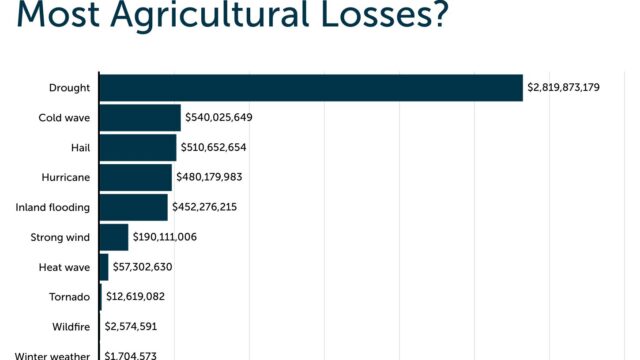
The increased frequency of natural hazards has created a challenging environment for farmers. However, the effects of climate- and weather-related disasters are not uniform, varying greatly depending on location.
To pinpoint where these events are having the greatest impact on farmers and the nation’s food supply, researchers at Trace One, a company providing compliance software to brands in food & beverage, cosmetics, and chemicals, conducted an in-depth analysis of the latest data from the U.S. Department of Agriculture (USDA) and the Federal Emergency Management Agency (FEMA).
And what are the findings for Hall County?
The newest data available shows Hall County farms are expected to lose a total of about $379.0K per year to natural disasters—an average per-farm loss of $660. The worst type of natural hazard for is drought, which can reduce water availability, shrink crop yields, and place added stress on livestock.
Nationally, USDA says there are just under 1.9 million farms that are responsible for producing nearly $527 billion in crop and livestock value annually. FEMA estimates that the country loses approximately $5.1 billion in agricultural value each year due to natural hazards—primarily drought—or more than $2,700 per farm.
The full report is available here: https://www.traceone.com/resources/plm-compliance-blog/where-natural-disasters-are-having-biggest-impact-on-u-s-food-supply