

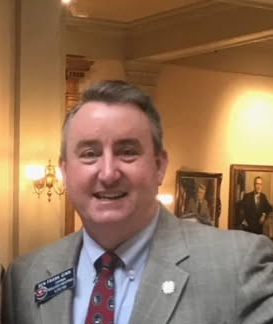
“Most Georgians don’t think twice about turning on the tap to wash their hands or clean up after a meal with family and friends,” a state lawmaker from northeast Georgia says, “but behind every drop is a water system that requires planning, investment and collaboration to be reliable and safe.”
Now, Sen. Frank Ginn, who represents Madison County and parts of Jackson, Barrow, and Clarke, is proposing a new water authority for our corner of the state.
“At the end of the 2025 Legislative Session, I sponsored Senate Bill 368 to get a head start for the following legislative session, where the bill would remain available for a vote,” Sen. Ginn said. “This bill establishes the Northeast Regional Water Authority and would protect Georgia’s water supply for future generations by creating an organization dedicated to managing and investing in northeast Georgia’s most critical resource: water.
“When our water supply runs short, local governments are forced to do more with less. The demands from residents, businesses and farmers don’t change, but our supply can decrease dramatically. During the driest spells, our state has even had disputes with neighboring states for the right to draw water from shared rivers and streams. You remember the ‘Tri-State Water Wars,’ (which involved a dispute over water in Lake Lanier and the Appalachicola-Chattahoochee-Flint River Basin)?”
Ginn says Northeast Regional Water Authority Act would establish a framework for effective water management by bringing together local governments in Banks, Elbert, Franklin, Jackson and Madison counties. The Authority would also collaborate with cities and other public water systems in the region.
SB 368 would also provide the Authority with the power to acquire, construct and maintain regional water supply reservoirs and sell water-related facilities. Additionally, it would be able to issue revenue bonds and partner with state and federal agencies, such as the Georgia Environmental Protection Division of the Department of Natural Resources, the Georgia Environmental Finance Authority and the U.S. Army Corps of Engineers.
The Authority would operate on a self-sustaining basis, using revenue from water services to fund future projects, without placing an additional burden on state taxpayers, Ginn said.
“It is my honor to introduce this common-sense approach to a growing challenge,” Sen. Ginn said, “and I look forward to continuing to work on this bill during the 2026 legislative session, or however long it may take!”