

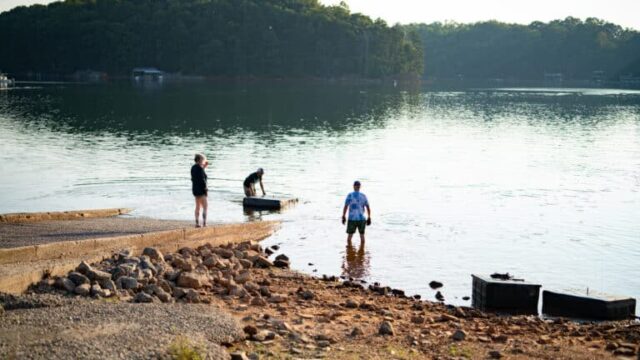
Despite several periods of heavy rainfall over the past two years, Lake Lanier continues to decline because the region remains mired in a long-term rainfall deficit and inflows into the reservoir remain well below required downstream releases, according to the Lake Lanier Association.
In an open letter to members, the group’s Vice President and Secretary, Clyde Morris, said questions about the lake’s falling water level are understandable, particularly after months that appeared wetter than normal.
“We know many of you have questions and concerns about Lake Lanier’s current water levels,” Morris wrote. “With the lake continuing to fall, it’s understandable to wonder why that is happening after periods of significant rainfall and when the U.S. Army Corps of Engineers will begin storing water again.”
According to data cited by Morris, rainfall in the Lake Lanier basin during the summer was below normal overall. While July received 142% of its average rainfall, June and August were significantly drier than normal, resulting in a seasonal rainfall total of 10.95 inches compared to a historical average of 13.38 inches, or about 82% of normal rainfall.
He notes that without the above-average rainfall recorded in May and July, Lake Lanier would likely be at much lower levels today.
The larger concern, Morris said, is the cumulative impact of a multi-year rainfall shortage. Using data from the National Weather Service (NWS) station in Gainesville, he reports that the area received approximately 92.15 inches of rainfall between August 2024 and August this year, compared to an expected 111.4 inches. That represents a deficit of roughly 19.25 inches, or about 17% below normal.
The figures suggest, he says, that north Georgia has experienced a prolonged drought pattern interrupted only by occasional periods of heavy rainfall.
“Those episodes of heavy rainfall have periodically replenished Lake Lanier and masked the severity of the underlying cumulative rainfall deficit,” Morris wrote. “Without them, the lake would be substantially lower today.”
One notable exception occurred in September 2024 when rainfall exceeded 10 inches due largely to Hurricane Helene. However, he points out, those isolated wet months were not enough to erase the growing long-term deficit that accumulated through 2025 and into this year.
Morris pointed to the historic 2007 drought, when the lake fell to its record low elevation of 1,050.79 feet, as an example of what can happen when prolonged dry conditions persist without substantial recovery periods.
In his letter, he notes the Corps is currently releasing only the minimum amount of water required to meet downstream water-supply and water-quality needs. However, inflows into the lake have been extremely limited. (EDITOR’S NOTE: Morris’ letter was written before the Corps’ recent announcement that it is releasing water from the lake daily to replenish downstream reservoirs and for navigation purposes.)
So far this month, inflows have averaged just 338 cubic feet per second (cfs), while required downstream releases have averaged approximately 1,230 cfs. That imbalance creates a daily deficit of about 892 cfs, causing lake levels to decline steadily.
“That, in a nutshell, is why the lake is dropping so quickly,” Morris wrote.
As for when the Corps might begin storing more water, Morris said the answer depends on operational rules outlined in the Apalachicola-Chattahoochee-Flint (ACF) Water Control Manual and on storage conditions throughout the entire river basin.
Morris said one of the biggest misconceptions surrounding Lake Lanier is the longstanding belief that the Corps intentionally lowers the lake each winter and refills it each spring.
“The often-mentioned theories about the Corps ‘drawing down’ the lake for winter and ‘refilling it’ in the spring are relics of a time before the Water Control Manual went into effect,” Morris wrote.
While water-management decisions play a role, Morris concluded that the primary factor determining Lake Lanier’s level remains the same as it has always been: rainfall.
“The reality is much more complex,” he wrote, “but even so, it’s Mother Nature who is really pulling the strings, not the Corps.”
(This is an AI-assisted story.)